Every year, more than 1.5 million wildebeest, joined by hundreds of thousands of zebras and gazelles, embark on an extraordinary journey across the plains of the Serengeti and the Masai Mara. This is the Great Migration — a continuous movement driven by the search for water and fresh grazing land, and quite possibly the most spectacular wildlife show our planet has to offer.
An endless cycle
The migration has no real beginning or end: it’s a continuous loop that unfolds throughout the year across the Serengeti-Mara ecosystem. The herds follow a route shaped by the rains, covering nearly 800 kilometers each year between Tanzania and Kenya.
- December to March: wildebeest gather in the southern Serengeti and the Ngorongoro Crater, the calving season — with up to 8,000 births a day!
- April to May: they begin moving toward the central and western Serengeti
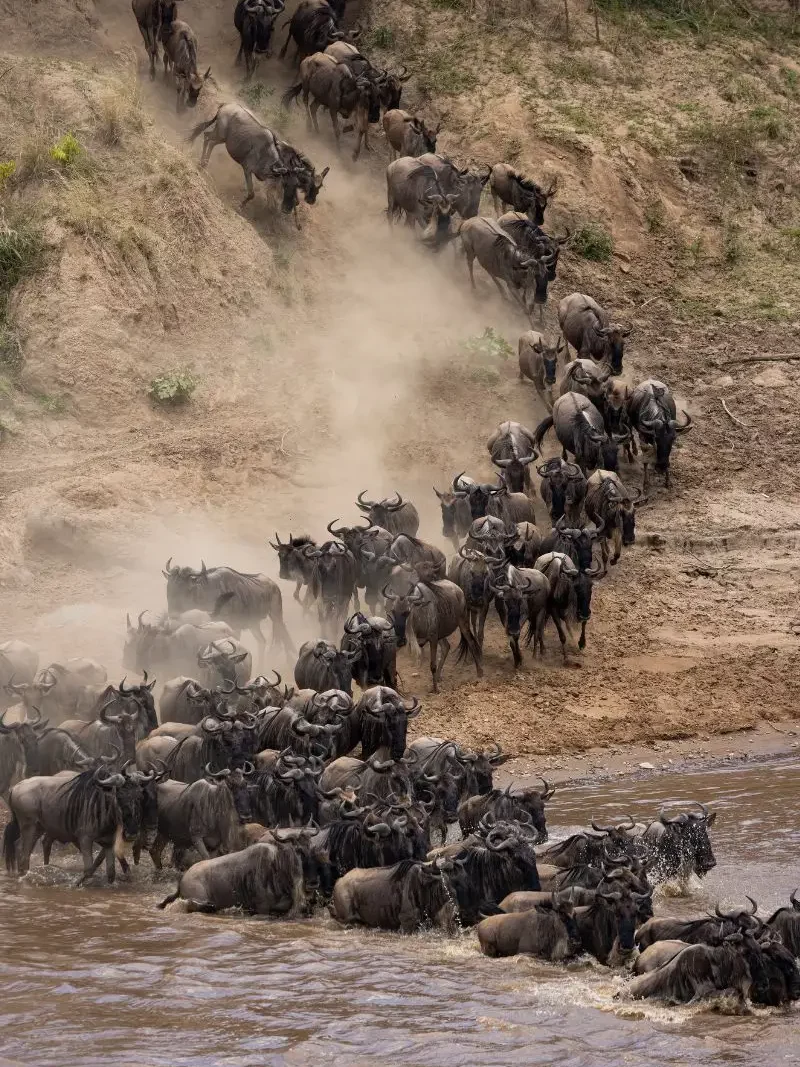
- June to July: the eagerly awaited crossing of the Grumeti River, the first major obstacle, teeming with crocodiles
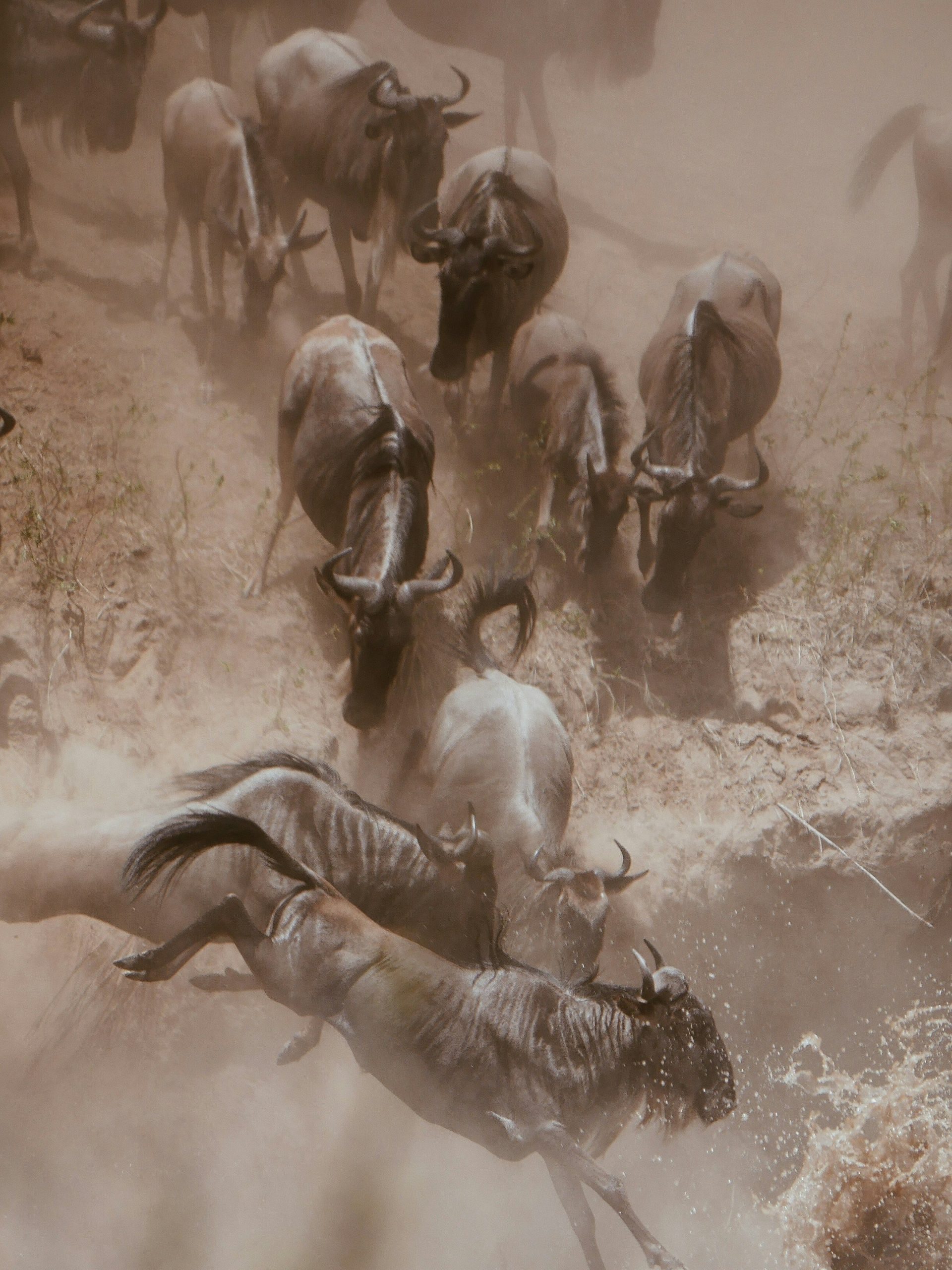
- August to October: the crossing of the Mara River, the climax of the spectacle, where predators and currents claim part of the herd every year
- November: the return south, and the cycle begins again
THE GREAT MIGRATION IN NUMBERS
1.3 MILLION WILDEBEEST
They form the heart of one of the largest land migrations in the world.
OVER 200,000 ZEBRAS JOIN THEM
Alongside the wildebeest, they travel across the plains of the Serengeti and the Maasai Mara.
1,000 KM TRAVELLED EACH YEAR
A vast annual cycle through Tanzania and Kenya, in search of water and fresh grazing lands.
UP TO 500,000 BIRTHS IN A SINGLE YEAR
The calving season transforms the southern Serengeti plains into a vast open-air nursery.
Why it’s an experience like no other
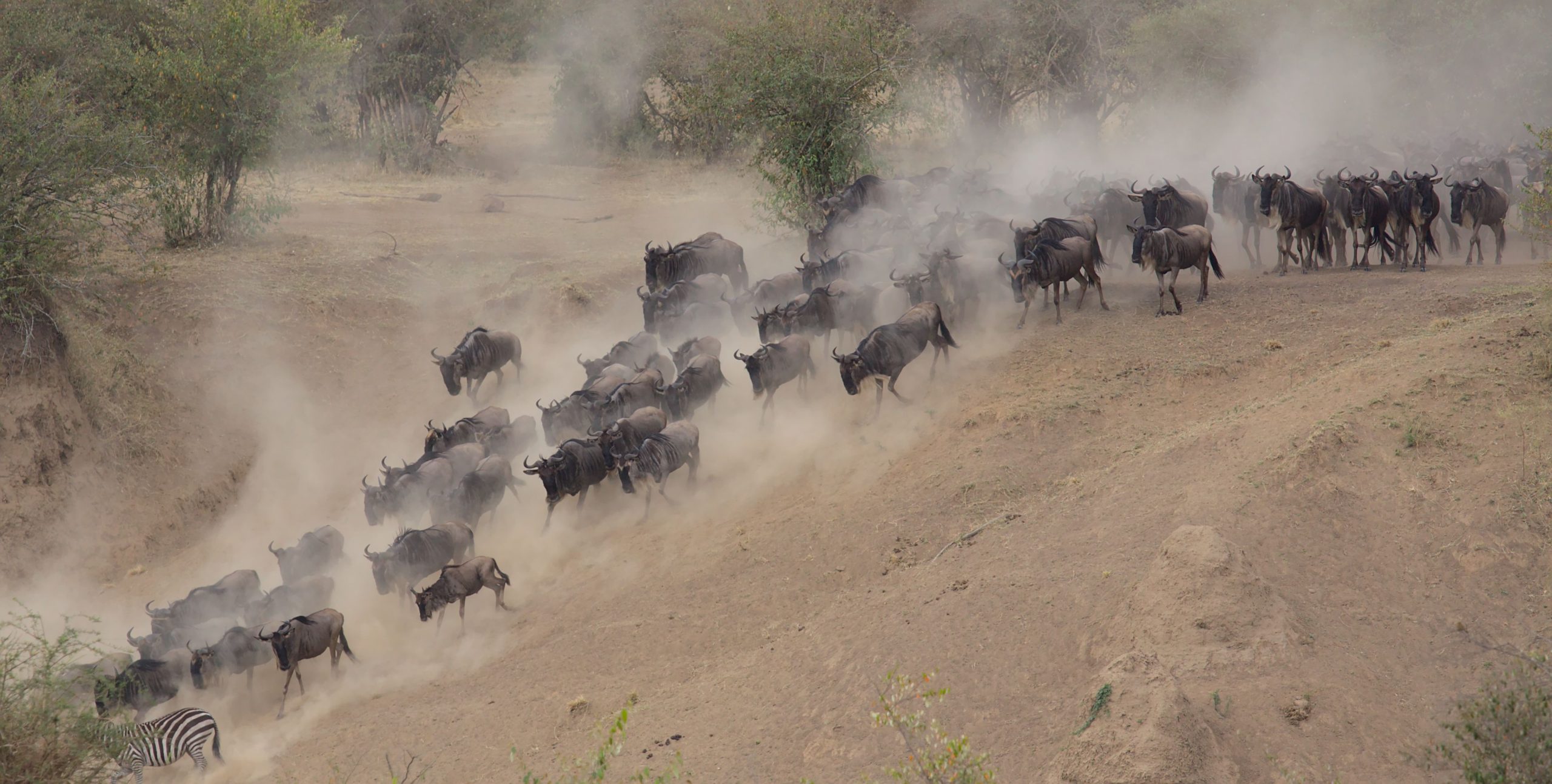
Beyond the sheer number of animals, what truly strikes travelers is the constant tension between life and survival. Lions, cheetahs, hyenas and crocodiles lie in wait at every river crossing, turning each stage of the journey into a scene of pure tension, worthy of the greatest wildlife documentaries.
When and where to see it
If you’re traveling between June and October, the central and northwestern Serengeti offers the best chances of witnessing a river crossing. Between December and March, head instead to the southern Serengeti and the Ngorongoro Crater to observe the calving season and the impressive concentration of herds.
Our agency’s advice
The Great Migration is a phenomenon that is as spectacular as it is unpredictable. Contrary to what one might think, there is no precise calendar that can tell us exactly where the herds will be on any given date.
Everything depends on rainfall, water availability, and the growth of fresh grass. One year, the wildebeest may arrive earlier in a particular region; the following year, the same herds may be delayed or change their route according to natural conditions.
Our goal is not to promise you a spectacle that cannot be guaranteed — nature remains free and unpredictable — but to give you the very best chance of experiencing the Great Migration up close.
River crossings, endless herds stretching as far as the eye can see, the calving season, or dramatic predator-prey encounters: each period offers a completely different experience. Together, we help you choose the one that best matches what you dream of experiencing.
Want to experience the Great Migration up close? Request your tailor-made quote to build your safari in Tanzania.